
The cupping table is the most democratic institution in the specialty coffee world. It does not care about marketing claims, sustainability certifications, or the elegance of a brand’s packaging. It cares about what is in the cup. When the hot water hits the grounds, when the crust breaks, when the spoon lifts and the liquid crosses the palate — at that moment, every assertion a roastery makes about its coffee is either confirmed or quietly exposed.
So when Snob’s Coffee invited a panel of certified Q-graders and experienced specialty buyers to evaluate solar-roasted coffee against conventionally roasted equivalents from the same green lot, the cupping table was the only authority that mattered. The question on the table — literally and figuratively — was whether the energy source used in roasting produces a measurable, describable difference in the cup. The answer, it turned out, was more nuanced and more interesting than a simple yes or no.
Setting Up the Comparison
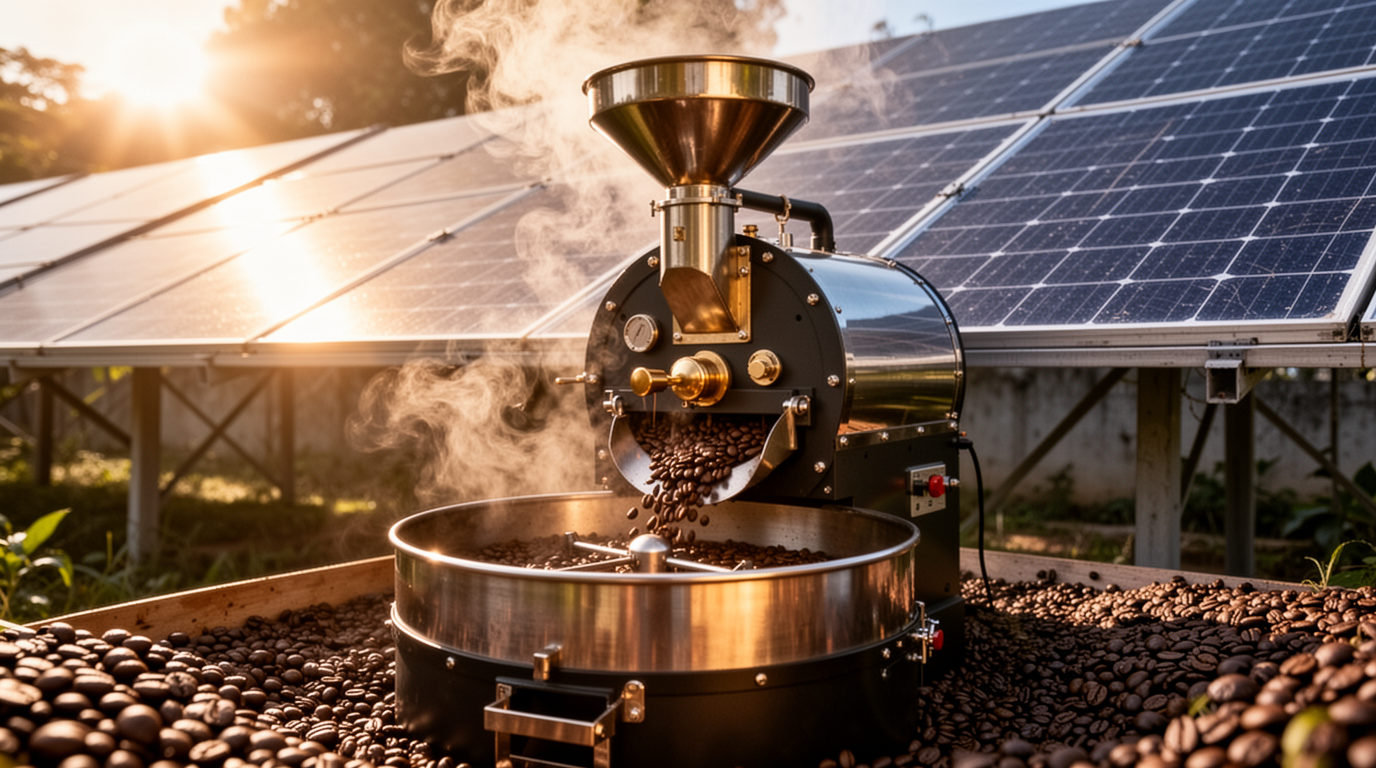
The methodology was straightforward in design and rigorous in execution. Identical green coffee lots — a washed Ethiopian Yirgacheffe and a natural Guatemalan from Huehuetenango — were roasted to matching development times and color readings using two different energy sources: Snob’s solar-powered roasting system and a conventional gas-fired drum roaster operating under standard commercial conditions. Roast profiles were calibrated as closely as possible to eliminate variables unrelated to energy source. Samples were cupped blind, with panelists unaware of which sample corresponded to which roasting method.
The panel convened over two sessions, allowing for fatigue management and ensuring that individual assessments could be cross-referenced for consistency. Scores were recorded using the Specialty Coffee Association’s standardized cupping form, covering fragrance, aroma, flavor, aftertaste, acidity, body, balance, uniformity, clean cup, and overall impression.
What the Panel Found
Across both origins, the solar-roasted samples scored marginally but consistently higher in two specific categories: clean cup and aftertaste. Panelists described the solar-roasted Ethiopian as exhibiting a clarity in its floral and stone fruit notes that felt less obscured — “more transparent,” in the language of one evaluator — than its conventionally roasted counterpart. The aftertaste lingered longer and resolved more cleanly, without the faint carbonic edge that some panelists identified in the gas-roasted sample.
The Guatemalan showed a similar pattern, with the solar-roasted version receiving notably higher marks for balance. Where the conventional sample presented its chocolate and walnut notes in a slightly compressed, less differentiated profile, the solar-roasted cup allowed those flavors more individual expression — what one panelist described as “more room between the notes.”
Body scores were comparable across both methods, and neither version was considered deficient in any category. The differences were not dramatic enough to suggest that energy source alone transforms an ordinary coffee into an extraordinary one. But they were consistent enough, across two distinct origins and across multiple sessions, to suggest that the relationship between energy delivery and cup quality is real and worth taking seriously.
The Theoretical Basis
Why might solar-roasted coffee taste different? The answer lies partly in the nature of energy delivery. Solar-powered roasting systems, particularly those incorporating infrared technology, tend to deliver heat with greater consistency and lower volatility than gas systems subject to pressure fluctuations and combustion byproducts. The absence of combustion gases in the roasting environment means that the beans develop in a cleaner thermal atmosphere — one free from the trace compounds that gas combustion can introduce.
Additionally, the precise, data-driven control enabled by modern solar roasting infrastructure allows for more stable rate-of-rise curves during the critical development phase, when the Maillard reaction and caramelization processes that define flavor complexity are most active. Greater stability in this phase may allow a fuller range of volatile aromatic compounds to develop without being driven off by excessive heat spikes.
The Verdict
Does the sun taste different? The professional consensus from Snob’s cupping panel is cautious but affirmative. The differences are subtle rather than dramatic, and they operate at the level of refinement rather than transformation. But in the specialty coffee world, refinement is everything. The distance between a score of 86 and 89 on the SCA scale is not a large number. It is the difference between a very good coffee and an exceptional one.
Solar roasting, the evidence suggests, creates conditions in which the exceptional becomes more consistently achievable. The sun, it turns out, does taste a little different. And in the right cup, that difference is worth seeking out.